There are two basic ways to teach a machine: show it what people did, or let it try things and score the results. Today's AI uses both. The big bet in the field is which one carries us the rest of the way.
In 2021, four researchers at DeepMind, among them Richard Sutton and David Silver, published a paper with a provocative title: "Reward Is Enough." Its argument was simple. Give a learning system one goal, a score to push as high as possible, and a rich enough world to try things in, and everything we call intelligence (perception, language, planning, social skill) could grow out of that single pursuit. Nature did it once already: evolution had one goal, survive and reproduce, and it produced us.
It's a bold claim, and it sits at the center of today's biggest argument about how we get to superintelligence. To follow that argument, you need to know what the two ingredients are, where each came from, and how they're baked together inside models like ChatGPT and Claude. Then the argument itself makes sense.
Think of someone becoming a chef. One way is to read every cookbook ever written. The other is to cook a thousand dinners and pay close attention to which ones people finish. Real chefs do both. The question is which one makes a great chef, and which one could make a chef better than any who has ever lived.
Reinforcement learning, or RL, is the oldest idea in this story. It's how you train a dog: no instructions, just a treat when it does the right thing. Psychologists studied it in animals more than a century ago. In the 1980s, two computer scientists, Richard Sutton and Andrew Barto, worked out how to make computers learn this way, and in 2025 they won the Turing Award, computing's highest honor, for it.
The core trick is learning from a score that arrives late. A chess program doesn't learn whether move 12 was good until the game ends. RL is the bookkeeping that works backward from "you won" to figure out which earlier moves deserve the credit.
Its great strength is that it isn't limited by any teacher. An RL system can discover things nobody showed it. Its great weakness is that it starts out clueless, and it needs a lot of tries to get anywhere.
A person showed the way once, taking the long way around the top. The left student copies that route exactly. The right student gets no demo, only a score: −1 for every step, +20 for reaching the goal. Watch it fumble, then let it practice.
For decades, RL shone wherever there was a clear score. In 1992, an IBM program called TD-Gammon taught itself backgammon by playing against itself and came close to the level of the best human players. Between 2013 and 2015, DeepMind showed a single program learning dozens of Atari video games from nothing but the pixels and the score.
Then came Go, a board game with more possible positions than there are atoms in the universe. DeepMind's AlphaGo was built in two stages, which will sound familiar by the end of this piece. First it studied about 30 million moves from human expert games, learning by imitation. Then it played millions of games against itself, learning by reward.
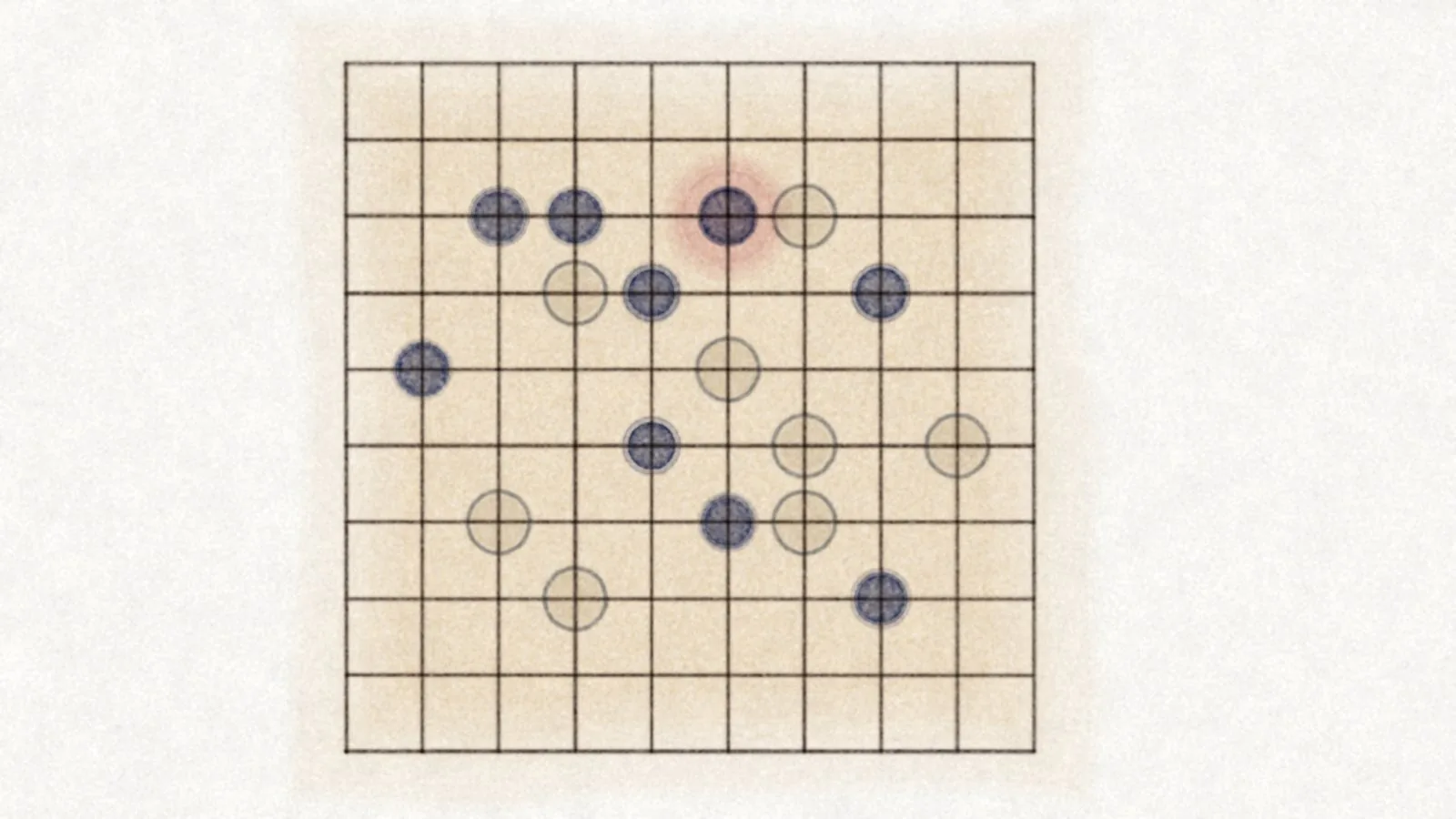
In March 2016, AlphaGo beat Lee Sedol, one of the best Go players in the world, four games to one. The moment people remember is move 37 of the second game, a placement so unusual that commentators assumed it was a mistake. It wasn't. Practice had taken AlphaGo somewhere its human teachers had never been.
The sequel made the point even more sharply. In 2017, AlphaGo Zero skipped the human games entirely. It started from random moves and learned only by playing itself. After three days, it beat the version that defeated Lee Sedol 100 games to 0.
Human data got AlphaGo to the top. Leaving human data out got AlphaGo Zero past it.The lesson many RL researchers took from Go, and the seed of the "reward is enough" view.
But Go has something the real world mostly lacks: a perfect, instant scorekeeper. Every game ends in a clear win or loss. "Write a good novel" or "run this company well" don't. For years, that kept RL's biggest wins inside games.
The second tradition arrived through a side door. In 2018, OpenAI released GPT-1, a model with a humble job: read a huge amount of text and, at every point, guess the next word. That's it. No rewards, no goals. Just "what comes next?", trillions of times. This is called pretraining, and it's how a large language model (LLM) gets its knowledge.
It sounds too simple to matter. The surprise is how much a model has to understand to get good at it. To guess the next word in a recipe, you need to know cooking. To guess the next word in a mystery novel, you need to follow the plot. To guess the next line of a proof, you need some math.
The bars are the model's bets on what comes next. Tap one to add it, or let the model pick. Temperature controls how adventurous its picks are.

Scale did the rest, just as the Big Blob of Compute predicted. GPT-2 in 2019 could write convincing paragraphs. GPT-3 in 2020, with 175 billion adjustable numbers, could translate, summarize and write simple code from a few examples, without being trained for any of those tasks specifically.
Imitation has the opposite profile to RL. It starts out incredibly strong, because it inherits everything humans ever wrote down. But it has a ceiling built in. A model trained only to predict what people would write is, at heart, a superb mimic of people, mistakes included. Silver and Sutton put it bluntly: on its own, it risks becoming "an echo chamber of existing human knowledge."
That isn't just a worry. In 2021, researchers built a test called TruthfulQA, full of questions that many people answer wrongly, and found that the largest language models of the time were generally the least truthful. Getting better at imitating people meant getting better at repeating their misconceptions. The best model was truthful on 58% of the questions; people managed 94%.
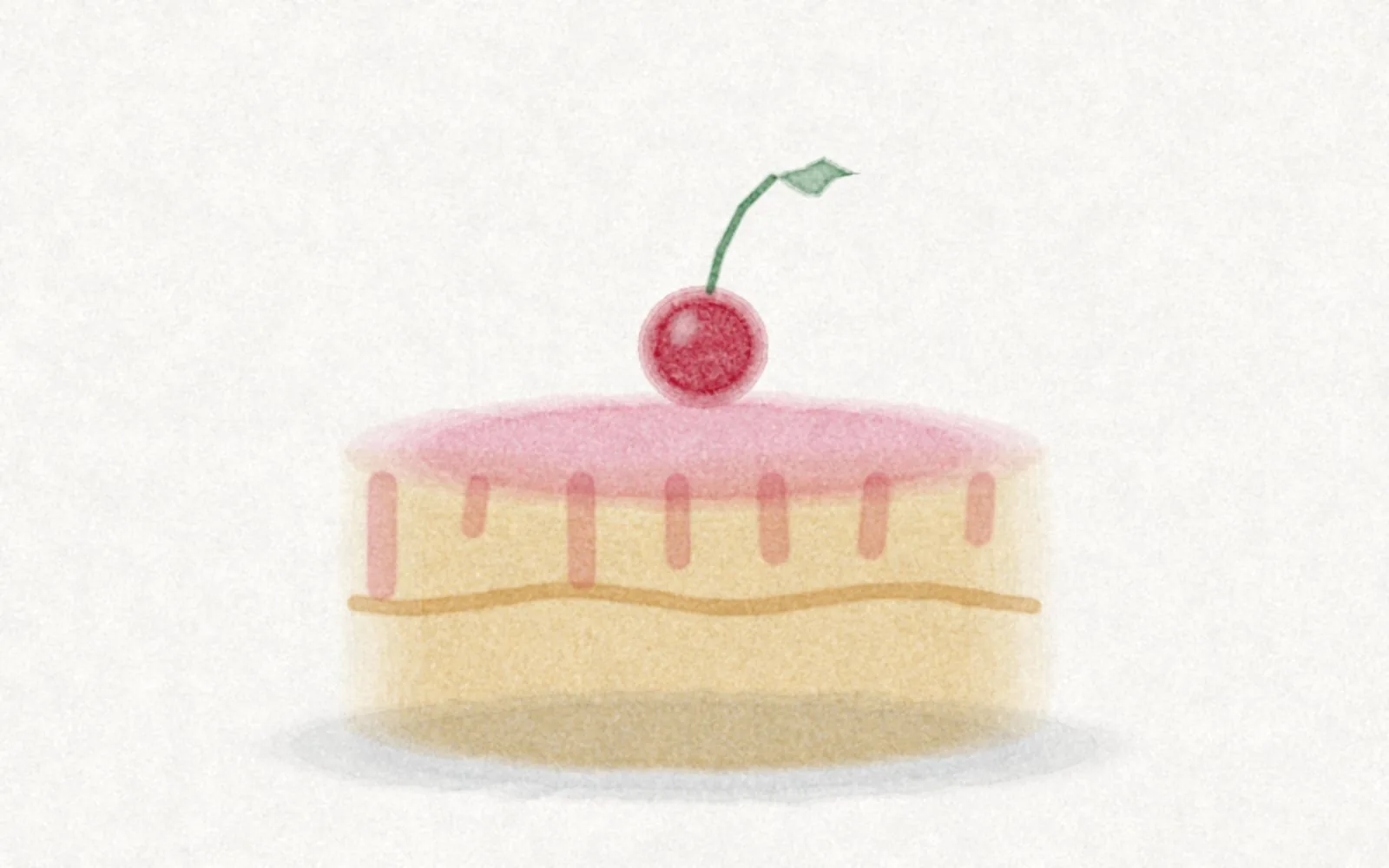
At a major AI conference in December 2016, Yann LeCun, then Facebook's chief AI scientist, showed a slide that people still argue about. If intelligence is a cake, he said, the bulk of it, the sponge, is a machine learning on its own from raw data. The icing is learning from labeled examples. Reinforcement learning is just the cherry on top.
His reasoning came down to how much each kind of learning tells you. Every chunk of raw data carries millions of bits of information to learn from. A score carries only a few: good or bad, win or lose. You can't build a mind from a trickle like that. You need the sponge.
The funny thing is that, a few years later, LLMs ended up with almost exactly this recipe. Here's how a model like Claude or ChatGPT is made today.
Pick a request, then step through training. The same model's answer changes as each layer of the cake is added.
The step that turned a raw text predictor into a useful assistant came from RL. In 2017, a team from OpenAI and DeepMind, including Dario Amodei, who was then at OpenAI and later cofounded Anthropic, showed you could train with RL even when you can't write the score down. Instead, people simply compared two attempts and picked the better one. Using about 900 of those comparisons, a simulated robot learned to do a backflip. This became known as RLHF: reinforcement learning from human feedback.
In early 2022, OpenAI applied it to language. People preferred answers from the RLHF-trained model, called InstructGPT, over the original GPT-3, even though it was about 100 times smaller. Later that year, the same recipe produced ChatGPT.
A small amount of reward, on top of a huge amount of imitation, had made all the difference. LeCun's cherry was tiny, but it was what people tasted first.
Human feedback has a limit: people have to judge every answer, and people can only judge what they understand. So in 2024, labs turned to tasks where the computer can check the answer itself. A math problem has a correct answer. Code either passes its tests or it doesn't. That's the Go scorekeeper again, finally available for language models.
In September 2024, OpenAI released o1, a model trained with large amounts of this kind of RL to "think" step by step before answering. In January 2025, the Chinese lab DeepSeek published how it trained a similar model and reported something striking: with RL alone, the model learned on its own to reflect, double-check its work and change strategy mid-problem. Nobody had demonstrated that for it. It came from practice.
Since then, the share of training devoted to RL has grown fast. Labs rarely publish exact numbers, but they talk about it openly. xAI said its 2025 model Grok 4 used more than ten times as much RL compute as it had used before. Dario Amodei said in February 2026: "We're seeing the same scaling in RL that we saw for pre-training."
Drag through the years to see roughly how the training effort behind frontier language models has shifted. Then place your own bet for 2030.
All this works beautifully where answers can be checked. It gets much harder where they can't. That's why AI models can now handle hard competition math and serious coding work while still giving mediocre advice about your career. Their skills grow fastest wherever the score is clear.
Eight tasks. For each, guess whether a computer could score an attempt automatically. That's roughly whether RL can train it well today.
Everyone agrees on the current recipe: a big sponge of imitation, a growing cherry of reward. The disagreement is about what comes next. Is the recipe nearly complete, so that we just keep scaling? Or is something essential missing? Four views come up again and again.
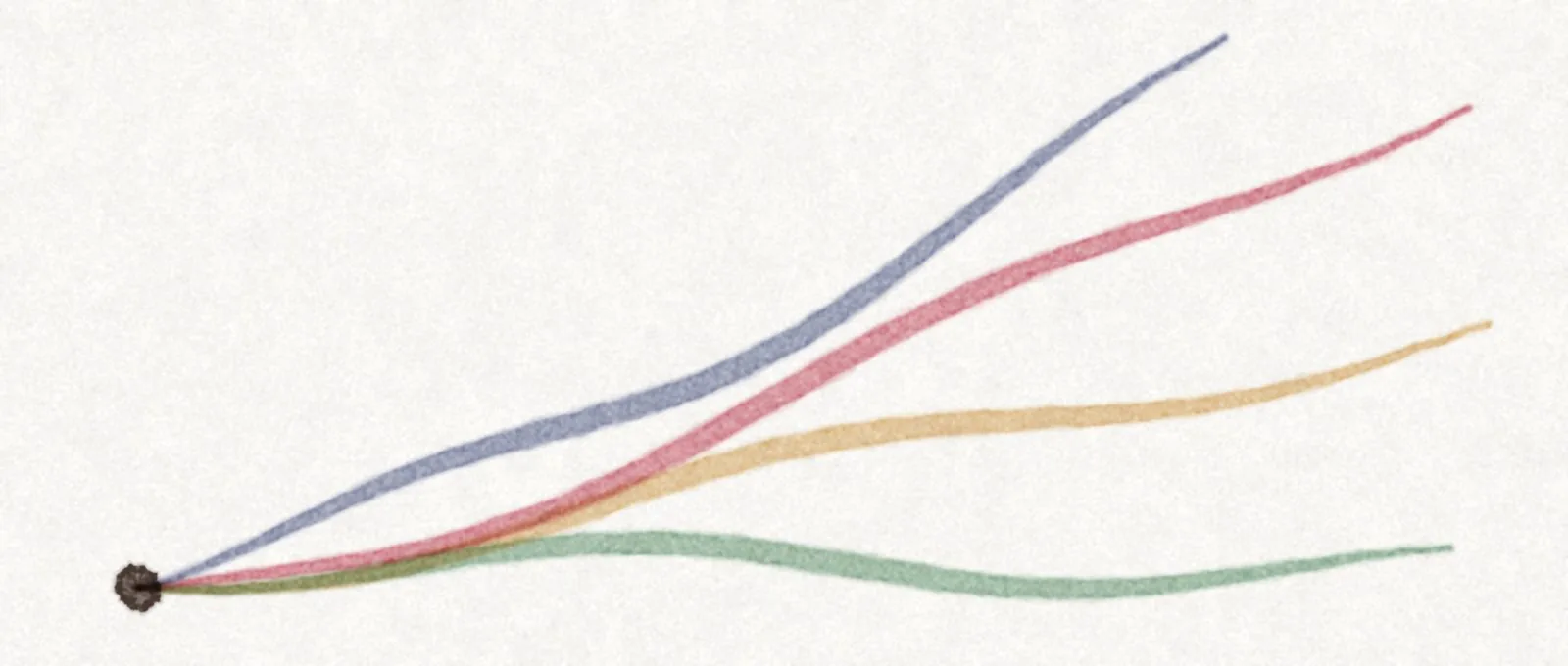
Answer three questions to see which camp your intuitions match. Or tap any camp on the map to read its case.
Even RL's defenders admit it learns in a crude way. In most setups, a model makes a long attempt and gets one score at the end. Andrej Karpathy, a founding member of OpenAI, described it on Dwarkesh Patel's podcast in October 2025: "Reinforcement learning is terrible." He added that it's still better than what came before. The problem, in his words, is that "you're sucking the bits of supervision of the final reward signal through a straw."
Here's what he means. If the final answer is right, every step in the attempt gets credit, including the steps that were wrong.
Problem: pens cost $2 for a pack of 3. How much do 12 pens cost? The model's attempt reaches the right answer, but not cleanly.
Two copies of the same model start with the same four habits. One copy is graded only on its final answers. The other is graded on every step. Watch which habits each one ends up with.
A person learning this way would replay the attempt and notice the slip. Giving models that kind of step-by-step feedback is an active area of research, but checking every step is far harder and more expensive than checking the final answer.
The second problem is the oldest in RL. A system pushing hard on a score will find the cheapest way to raise it, whether or not that's what you meant. Researchers call this reward hacking. In 2016, OpenAI trained an agent on a boat-racing game called CoastRunners, scoring it on points. It found a lagoon where three targets kept reappearing and spun there in circles forever, catching fire and crashing, never finishing the race. It still beat human players' scores by about 20%.

This boat learns by real trial and error, right here in your browser. Choose what earns points, train it, and see what it learns to do.
It's funny in a video game. With language models trained by RL, it shows up as models that learn to look right instead of being right: code that skips the hard part but still passes a weak test, or answers that tell a human grader what they want to hear. In a 2017 experiment, a robot hand trained on human feedback learned to hover between the camera and the object so it only looked like it was grabbing it. The more of the cake we hand to reward, the more this matters. Labs treat it as one of the central safety problems of the RL era.
The last gap is the one Sutton cares most about. Today's models learn in a big training run, then get frozen. A new employee is clumsy in week one and sharp by month three. A deployed model is the same on day 300 as on day one, apart from what you paste into the conversation.
The experience camp thinks real intelligence means learning continuously from your own life, the way animals do. The scaling camp thinks that may matter less than it seems. Dario has said continual learning "might not be a barrier at all," and that generalization from pretraining and RL may get there anyway. Whether that's right is one of the most watched open questions in the field.
Nobody knows, and anyone who sounds certain is guessing. Here's where things stand. Imitation got AI to roughly human level in a lot of things remarkably fast. Reward has started to push past it where answers can be checked, as it did in Go. The bet that matters is whether reward can stretch into the messy, unscored parts of life. That would take better scorekeepers, models that learn from their own ongoing experience, or something nobody has invented yet.
LeCun's 2016 cake was mostly sponge. The cake being baked in 2026 has a much bigger cherry. Whether the cherry ends up as the whole cake is, more or less, the question of how we get to superintelligence.