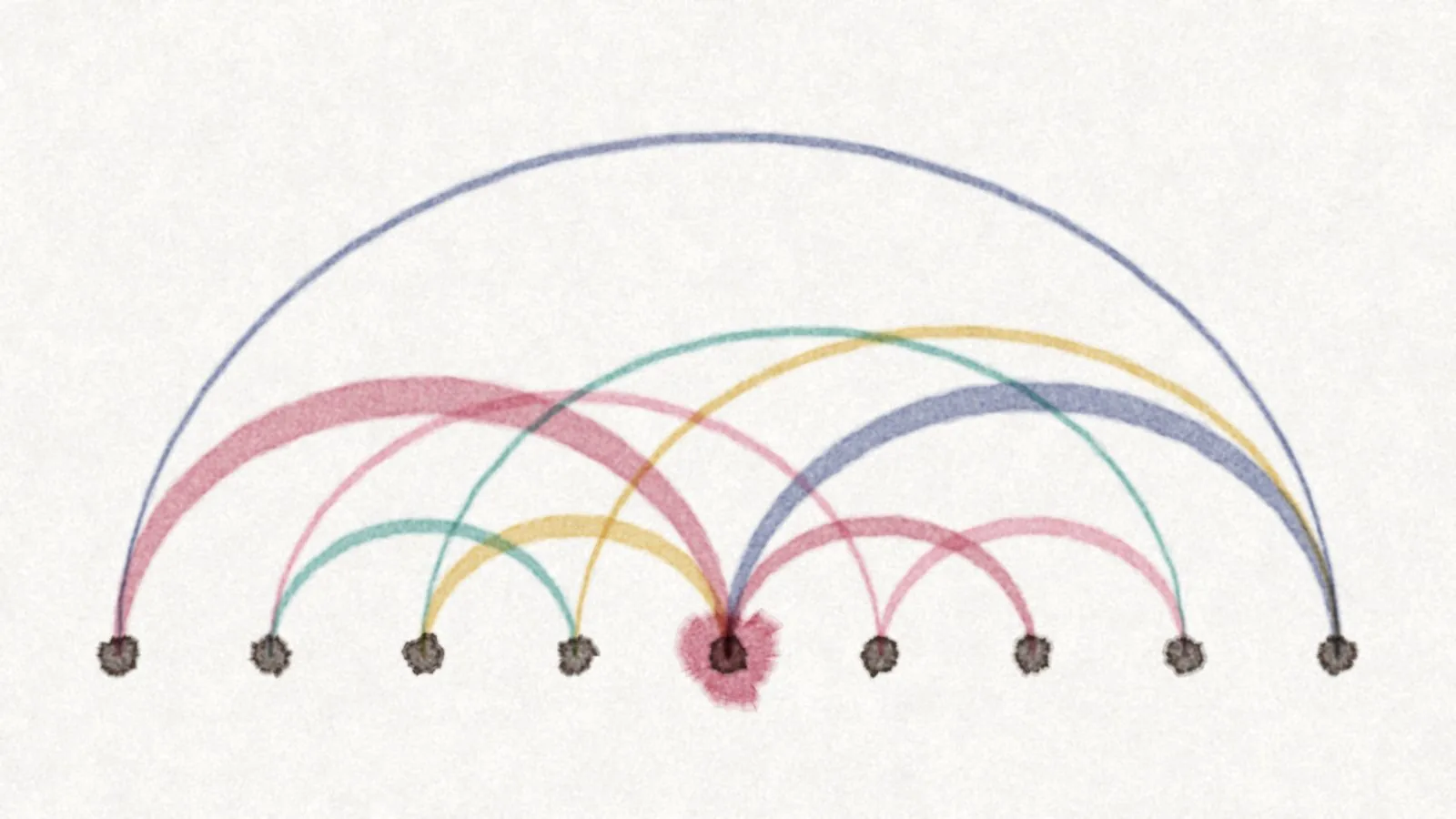
In 2017, eight researchers at Google published a 15-page paper about translating between languages. The design it introduced, the Transformer, now sits inside nearly every AI system you've heard of. It's the T in ChatGPT.
Before 2017, the best language AIs read the way you'd read a book through a keyhole: one word at a time, left to right, carrying a small summary of everything so far in their heads. By the end of a long sentence, the start had mostly faded, like the first message in a game of telephone.
There was a second, less obvious problem: speed. If you have to finish word 49 before you can start word 50, it doesn't matter how many computer chips you own. They all wait in line. That made it very hard to feed these systems the huge amounts of text and computing power that make AI good, the "Big Blob of Compute" from the first piece in this series.
Press play. The old way reads one word per step, and earlier words fade. The new way takes in every word at once.
The paper's answer was a mechanism called attention. Instead of reading through a keyhole, each word gets to look across the whole sentence and decide which other words matter most for understanding it.
The classic example is a sentence with a tricky "it". In "The animal didn't cross the street because it was too tired", "it" means the animal. Change one word, "…because it was too wide", and "it" now means the street. You figured that out instantly by glancing back at the right word. Attention lets a model do the same.
The highlight shows how much attention the selected word pays to each other word. Then flip the last word.
The paper describes attention with three words that sound technical but map neatly onto a party. You walk in looking for someone who can tell you about football.
"Anyone here into football?" Every word asks its own question.
"Sports fan." "Chef." "Coach." Every word advertises what it's about.
Once you pick who to listen to, you take away what they say, weighted by how much you listened.
Here's that process for the word "it", step by step.
Each word's key is compared with the query. A better match gets a higher score.
Scores become percentages that add up to 100%. Big scores get most of the budget.
One highlighter can only track one kind of relationship. So the Transformer runs several attention "heads" side by side, each free to learn its own job. The original paper used eight. One head might track who did what, another who a pronoun refers to, another when things happened. Their findings are combined at the end.
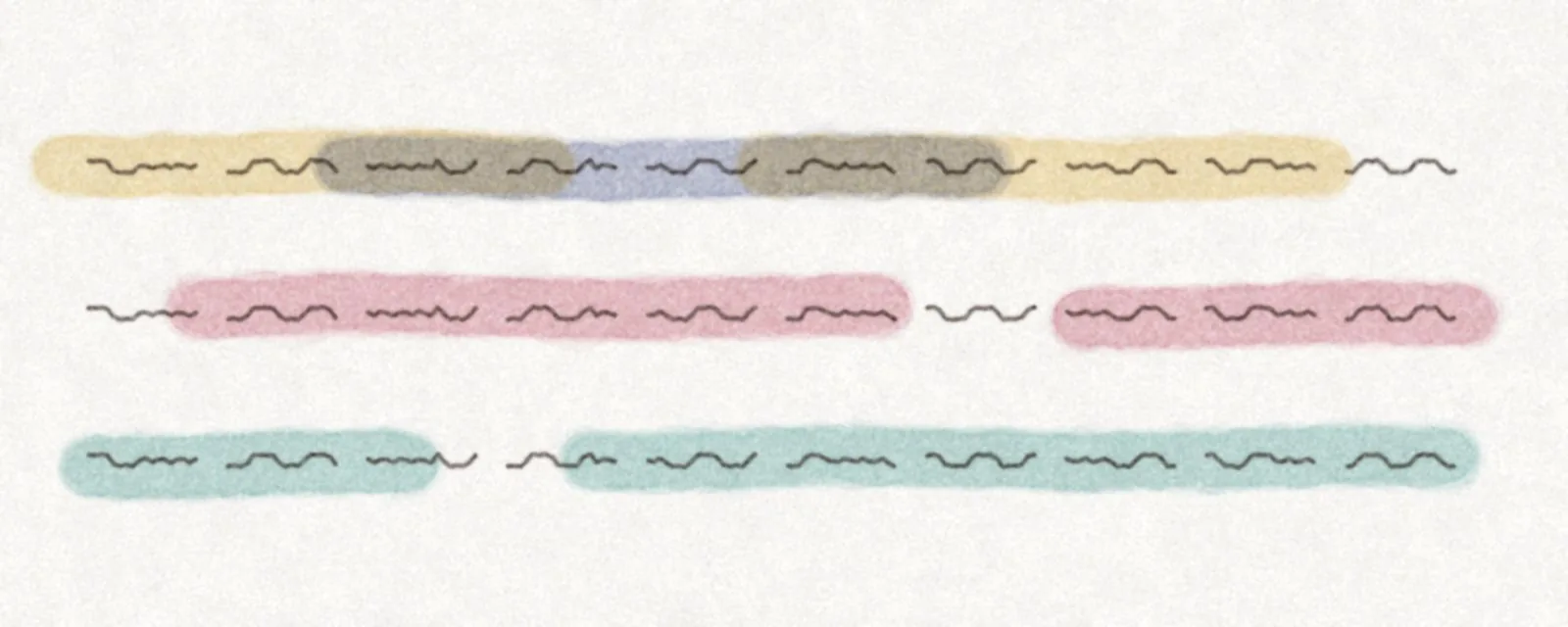
Each head notices a different kind of link in the same sentence.
Reading everything at once creates a new problem. If the model sees the whole sentence as one pile of words, then "dog bites man" and "man bites dog" are the same pile. The fix is simple: before anything else, every word gets its position stamped on it, like a seat number on a concert ticket. The paper did this with a pattern of waves, which works for sentences of any length.
On its own, attention was a nice improvement in quality. What made it historic was that it threw out the one-word-at-a-time reading entirely. That's what the title means: you don't need the old machinery, attention is enough.
With every word processed at the same moment, a Transformer can keep thousands of chips busy at once, like opening a hundred checkout lanes instead of one. Suddenly it was practical to train on far more text, far faster. This is the bridge between the two ideas in this series: the Transformer is the design that let the Big Blob of Compute be poured into language.
The paper's results were about translation, and it beat the best existing systems while costing a fraction as much to train. But the authors guessed it might work for other kinds of data too. They were right.
Within about a year, OpenAI's first GPT (the T is "Transformer") and Google's BERT showed the design worked far beyond translation. Since then it has spread to chatbots like ChatGPT and Claude, image generators, speech recognition, and even systems that predict the shapes of proteins. It is one of the most cited scientific papers of the century.
Two footnotes people love. The title is a nod to the Beatles' "All You Need Is Love". And all eight authors eventually left Google; several went on to found AI companies of their own.